“Double Take” is a new feature where I spotlight art that made me stop and pay attention. My hope (along with my hope for the entire site) is that I could encourage audiences and viewers to slow down and dig into works despite the ever-present volume of material to consume in the digital age.
June’s First Friday coincided with the Dogwood Arts Regional Exhibition and a steady rain, which, thankfully, drove people inside to spend more time with pieces that deserved quality time.
See if you can spot what these three pieces have in common:


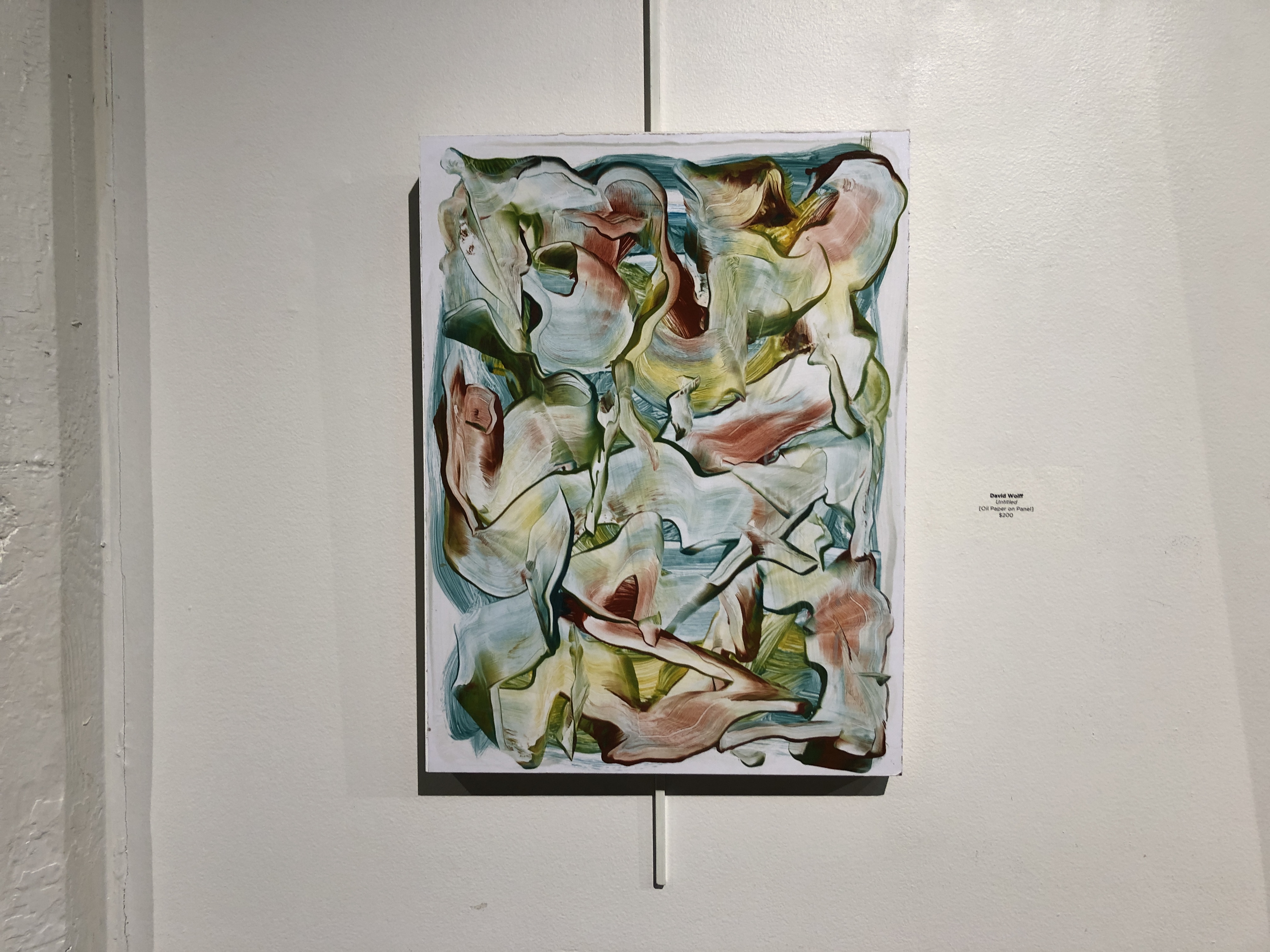
Untitled! All of them! Which is great: these abstract pieces are valuable precisely because they are non-verbal. Works like this strong arm our language-dependent brains out the door. What remains are our senses, and what a gift. Bombarded by advertisements and social media, what a treat to be offered an image celebrating color, form, harmony, etc. without a call to action. David Wolff’s painting is the sort that is wild enough to produce curiosity from across the room but unified enough at close inspection to beckon deeper consideration. Colors from a landscape palette take on landscape forms, but without a discernible horizon, suggesting a riverside scene painted from every angle at once, moving fluidly between POVs as a river itself might.
My favorite painting at the show? Yet another titled Untitled. This time by Amanda Nolan Booker from Chattanooga.
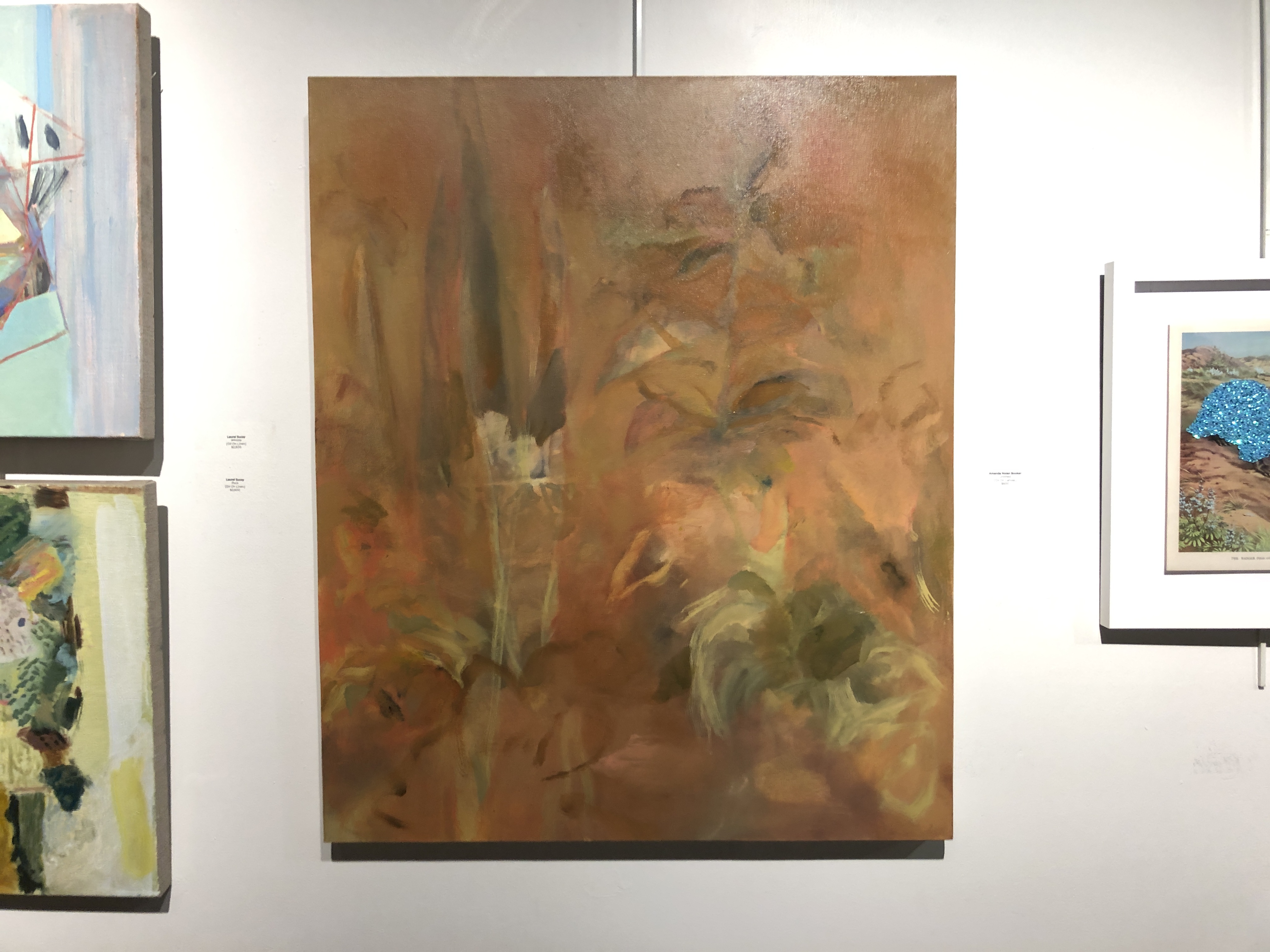
As far as the painting’s subject, I can only offer my best guess. We’ve got flora of some kind suggested by leafy green strokes and dim stems on the right, and something like a small end table propped up on thin legs to the left. It’s a still life, apparently. But, obviously, the subject is being absolutely obliterated by a heavy, burnt orange. The dynamic between discernible image and abstraction is electric. The confused subject is domestic and painterly, but the portrayal swallows the subject whole, at once violent and warm. What’s left is clouded and mystifying, like a memory. Booker elegantly breeds antiquated museum styles like still life and ab-ex and the offspring is refreshing.
Next door, UT’s Downtown Gallery had an exhibition of Carl Sublett’s painting. Sublett was a painting professor at the university through the 80s, and I couldn’t help but draw some comparison’s between his use of paint and Booker’s above.

Again, something recognizable (an ocean inlet) obscured in the process of trying to paint it. Aside from saying something about the nature of reproduction or memory, Sublett is laying color and pure form on top of the scene to exaggerate its formal elements. A haphazard creek or dune is translated as a forking shock of blue and yellow. The horizon is designated from both land and sky as its own brush stroke. The ocean is a dark and deep, stony navy–color suggesting dimension. I agree with all of these choices. Each name an effect the beach has had on me. In the same way that Booker’s work encouraged a reassessment of still life convention, Sublett’s was reviving the landscape painting with unpredictability and (therefore) electricity.
My last stop was Salvage Shop Studios, a tiny upstairs space on Broadway supporting artists Michael Giles and Ashley Addair, who work together under the “Practices Of” moniker.
Their new installation “i.e. interact/experiment” incorporated so many separate elements that it would be hard to discuss the work without breaking down and listing them. The installation included:
- On one wall of a dark room, a looped projection of Ashley dancing behind superimposed greater-than/less-than signs
- Sheets of translucent white paper and screen material that hung limply in front of the projection wall and caught bits of the projection
- Loud, aimless blues music
- White paint on several surfaces, including the screens
- Photocopied papers covering the floor, which upon close inspection were apparently Ashley and Michael’s handwritten notes for the show itself
- Ponchos with “for viewing and being viewed” printed on them and hanging from a wall near the projection
As you can tell from the picture below, the whole thing was staged between three walls and, like the message printed on the ponchos, felt very much like something to both be a part of and spectate.

Given the fact that the work sat in a small room only accessible by noisy wooden stairs, the only light in the room came from the projector, and the material on hand was somewhat austere (dance always carries something mystifying and primal about it), the installation achieved an aspect of alien transportation that I felt missing in last month’s exhibitions. But transportation to where?
You can’t help but notice how reflexive and meta the whole thing is. Notes from their process litter the ground. The viewer constitutes the thing to be viewed, at least in part. Things carry a rustic, unfinished aesthetic suggesting that, seeing as this is the studio where both artists currently work, viewers are breaking in on a work in progress. It is artwork about artwork, ostensibly, which can create problems.
For one, since it dramatizes the process, reflexive art risks alienating people that don’t make art. If the art is about art-making, what could non-artists find? On top of that, self-referential art adds a tempting shade of sophistication to a work, and when sophistication is part of the expectation (as it almost always is with the avant-garde), artists can reach too quickly for self-aware commentary instead of bold work about universal human experience.
Practices Of avoided both.
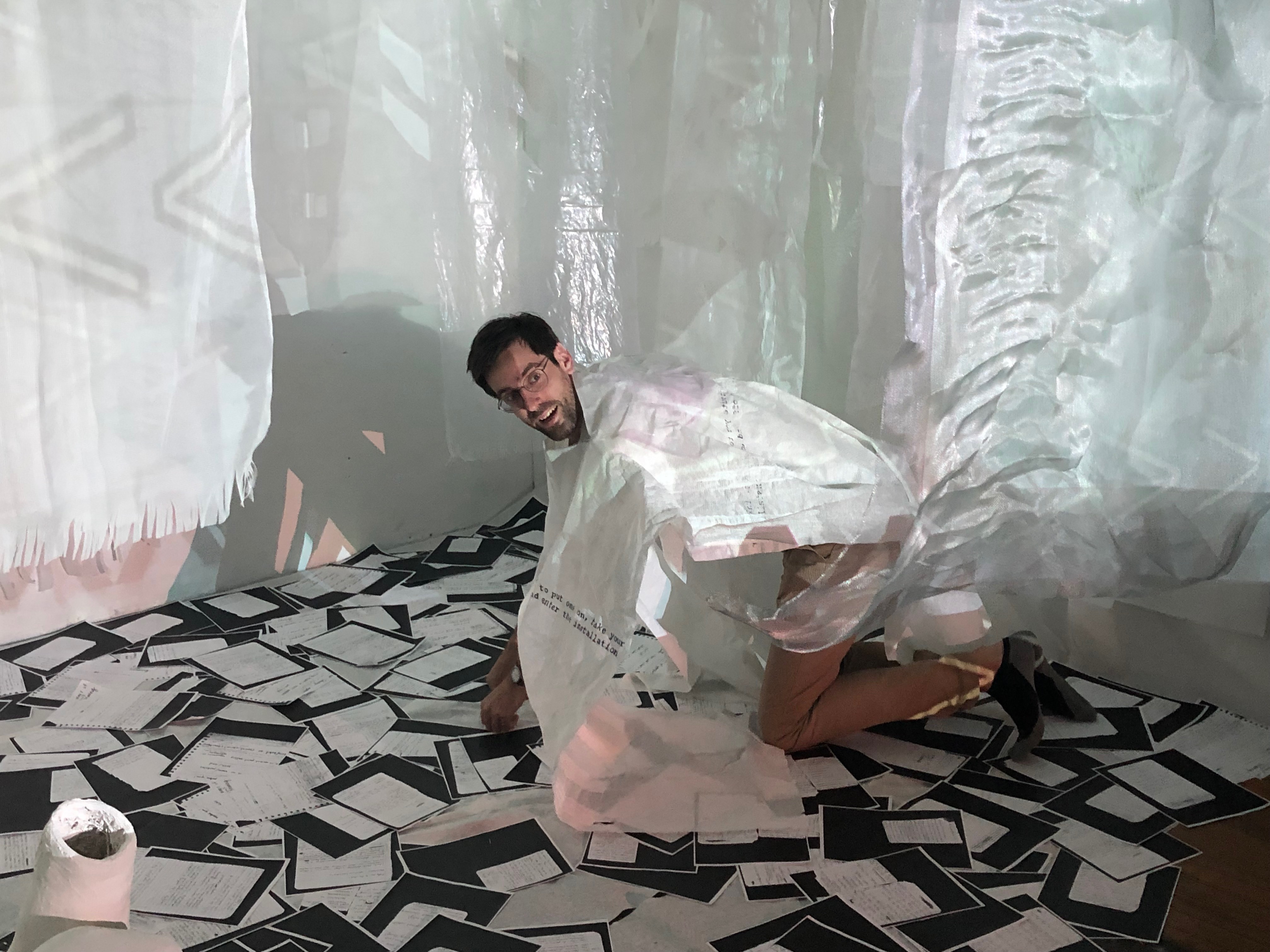
Here, self-awareness isn’t just particular to artists, but because viewers are complicit in the projected dance, it expands out to include all forms of self-awareness. Interact/experiment’s reflexive nature had less to do with an artist’s pretentious struggle with making art, but rather the common struggle against the very things that keep us from connecting with each other: insecurity, confusion, and prejudice. The viewer is encouraged toward productive vulnerability, just as Ashley and Michael were. They’ve put everything out there, and we should too.
Michael

 Balltower